TOKYO STILL MOTION
Tokyo in 16 movements
Tokyo Still Motion explores the paradox of constant movement and existential stasis in contemporary urban life. Tokyo, one of the most hyper-efficient and perpetually active cities in the world, becomes both subject and metaphor: a place where motion is continuous, yet meaning often feels suspended. Through long exposure photography and layered visual compositions, the series transforms movement into a perceptual condition rather than a narrative event.
Rather than freezing time, these images allow it to accumulate. Pedestrians dissolve into luminous traces, architecture bends and multiplies, and the city appears to breathe in overlapping rhythms. Individual figures lose clear contours and merge into collective flows, suggesting a gradual erosion of personal orientation within large-scale urban systems. The result is a dreamlike visual field, where clarity and disorientation coexist, and where the city feels simultaneously hyper-present and strangely unreal.
This dreamlike quality is not escapist but critical. The images reflect on alienation, repetition, and the subtle violence of systems designed for efficiency, speed, and control. In these environments, movement becomes compulsory rather than intentional, and the body is absorbed into choreographed circulations dictated by infrastructure, commerce, and algorithmic logic. Tokyo Still Motion asks what happens to subjective experience when motion never stops, yet direction feels absent.
The series deliberately avoids spectacular landmarks or iconic representations of Tokyo. Instead, it focuses on transitional spaces—crossings, corridors, malls, escalators, layered road systems—places designed to move people through rather than invite them to stay. By visually destabilizing these environments, the work reveals their latent psychological charge: a sense of drift, suspension, and quiet anxiety beneath the surface of everyday normality.
Tokyo functions here not as a portrait of a specific city, but as a condensed image of contemporary urban life globally. The dreamlike distortions point to a broader condition shared by many megacities, where individuals navigate environments that feel increasingly abstract, automated, and indifferent. In this sense, Tokyo Still Motion is less about documenting a place than about visualizing a state of being—one defined by perpetual motion, diffuse identity, and a longing for stillness that never fully arrives.
The sound supporting certain moving images has accompanied us since the creation of sound films. The sound-image relationship has become so intense that for me it is impossible to divide them, and precisely in this case, the images -with their corresponding soundtrack- acquire a whole new dimension. The wonderful music of Tomoo Nagai adds a new dimension to the work: its textures, its sounds – especially created for each of the images in this exhibition – weave with infinite delicacy a series of invisible paths that invite us to travel each work in a special way: a different way of discovering impossible landscapes through paths and directions suggested by soundscapes.
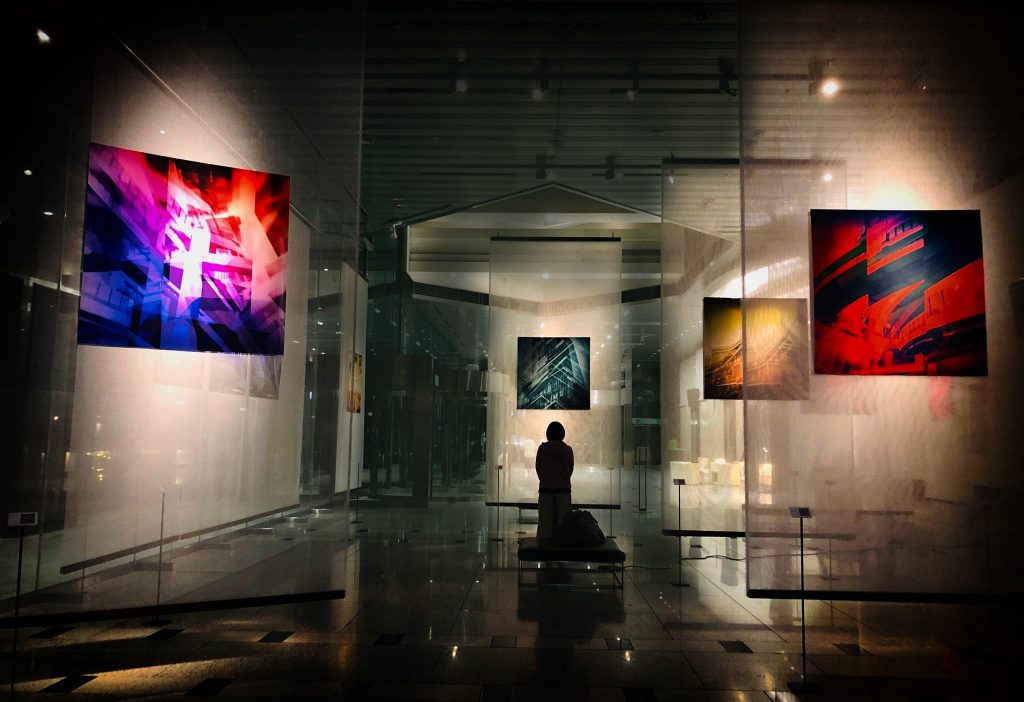
Tokyo Still Motion was exhibited in 2021 at Tennoz Isle Central Tower, Tokyo, as an immersive, site-responsive installation. The exhibition space was conceived as an extension of the visual logic of the work: a transitional environment rather than a conventional gallery, reinforcing the themes of movement, passage, and perceptual drift.
Each photographic work was paired with an original soundscape composed by Japanese musician Tomoo Nagai. These soundscapes were not played openly in the space but accessed individually through QR codes placed alongside each image. Visitors were invited to listen using headphones on their own devices, creating an intimate and introspective layer of experience within a public setting.
This approach emphasized a dual condition central to the project: collective movement and private perception. While viewers occupied the same architectural space, each experienced a distinct auditory environment, subtly altering their emotional and temporal relationship to the images. The soundscapes functioned as extensions of the dreamlike visual language—slow, textural, and atmospheric—blurring the boundary between external observation and inner reflection.
Marcelo von Schwartz and Tomoo Nagai, Tokyo, November 2021
 English