TOKYO STILL MOTION
Tokyo in 16 movements
Tokyo Still Motion explores a central paradox of contemporary urban life: the coexistence of constant movement and a persistent sense of existential suspension. Tokyo—one of the most hyper-efficient and perpetually active cities in the world—emerges here as both subject and condition: a place where motion is continuous, yet direction often feels absent.
In these environments, movement no longer operates as a means of reaching somewhere, but as an end in itself. It becomes habitual, compulsory—absorbing the body into systems of circulation shaped by infrastructure, commerce, and algorithmic logic. What is at stake is not simply speed, but a more subtle disorientation: a state in which one is constantly in motion, yet never fully arrives.
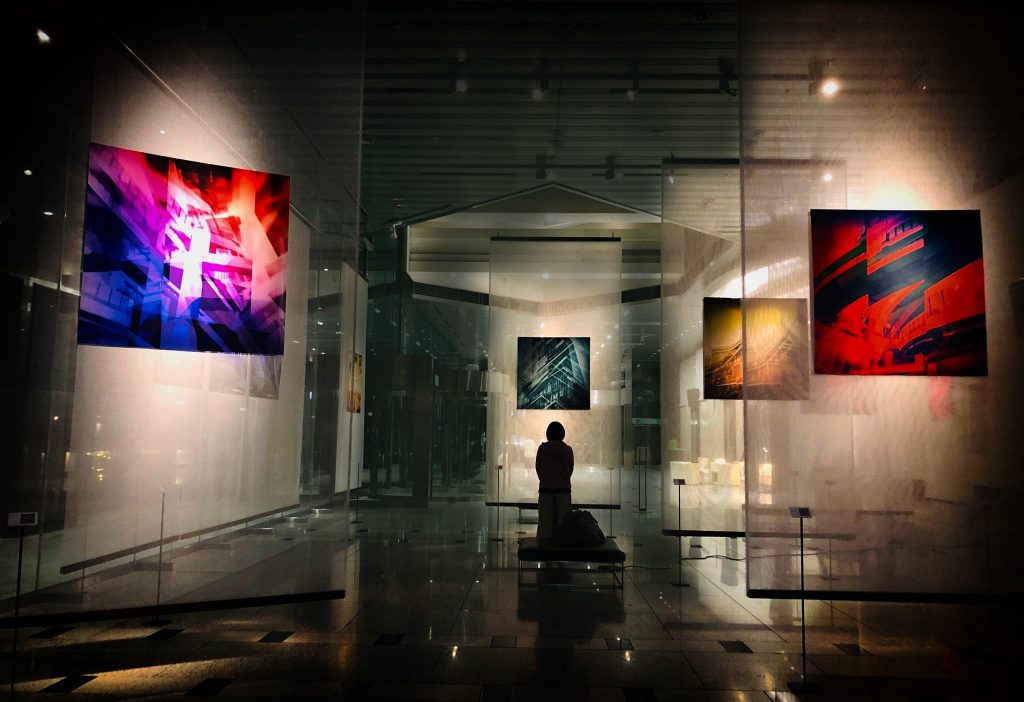
Through long exposure photography and layered visual compositions, the work does not seek to represent this movement, but to suspend its direction. Rather than freezing time, the images allow it to accumulate and disperse. Pedestrians dissolve into luminous traces, architecture bends and multiplies, and the city unfolds as a field of overlapping temporalities. Individual figures lose clear contours, merging into collective flows that suggest a gradual erosion of personal orientation.
What emerges is not a depiction of movement, but the experience of its drift.
There is something deceptively evident about movement. We tend to attribute it to things—bodies, crowds, cities—yet it does not fully belong to them. Movement is relational: it appears only when something shifts in relation to something that, at least provisionally, remains.
A moving landscape seen through a train window does not “contain” movement; it produces it through the gap between the advancing body and the seemingly still surroundings. Similarly, in certain Mannerist compositions, the surface remains fixed while the gaze is drawn into motion across it. In both cases, movement resides not simply in what is seen, but in how perception is structured.
Tokyo Still Motion situates itself precisely at the point where this relation begins to destabilize.
The city no longer offers a stable ground, and the image does not restore it. Instead, this instability is displaced toward the viewer. As Paul Klee suggested, the eye follows paths prepared by the work. Here, each image operates as a subtle choreography: lines, repetitions, and tensions that guide the gaze without fully determining it.
Yet this guidance does not resolve into stability. There is no clear point of rest. The gaze advances, deviates, returns. It remains in motion, but never fully settles.
In this process, the distinction between what moves and the position from which movement is perceived begins to blur. The image no longer provides a reliable point of stillness, and the gaze, once set in motion, temporarily occupies that role—though never securely.
Movement does not disappear. It shifts location.
It no longer belongs to the city or to the bodies that traverse it, but installs itself within perception itself. The gaze becomes its primary support. And yet, that gaze is not entirely free.
Its trajectories are suggested, channeled, constructed through visual decisions that quietly delimit the conditions of its movement. The spaces depicted—corridors, crossings, escalators, transit systems—are not merely settings, but structures of passage: environments designed to be crossed rather than inhabited.
Sound extends and complicates this condition. The compositions by Tomoo Nagai not only accompany the images; they introduce a parallel system of orientation. Their textures and rhythms generate invisible trajectories that intersect with the visual ones, subtly guiding attention and reshaping the temporal experience of each work.
Experienced individually through headphones, these soundscapes create a private auditory space within a shared environment. This produces a double articulation central to the project: while bodies move collectively through the exhibition, perception unfolds in singular, interiorized ways. Seeing and listening no longer coincide; they drift alongside one another, forming a layered choreography that the viewer inhabits but does not fully control.
What gradually emerges is a condition in which movement and direction no longer coincide. We move, but not necessarily by choice. We look, but within structures that organize vision in advance.
Perhaps the question that remains is not how we move through the city, but whether it is still possible to tell the difference between moving and being moved.
Marcelo von Schwartz and Tomoo Nagai, Tokyo, November 2021
 English